Aipan Art
ऐपणThe ritual red-and-white floor art of Kumaon, Uttarakhand
Aipan is the ritual folk art of Kumaon, drawn freehand in white rice paste on a deep red-ochre ground. It marks thresholds, courtyards and worship spaces at every festival, puja and life ceremony, and in 2021 it received a Geographical Indication tag.
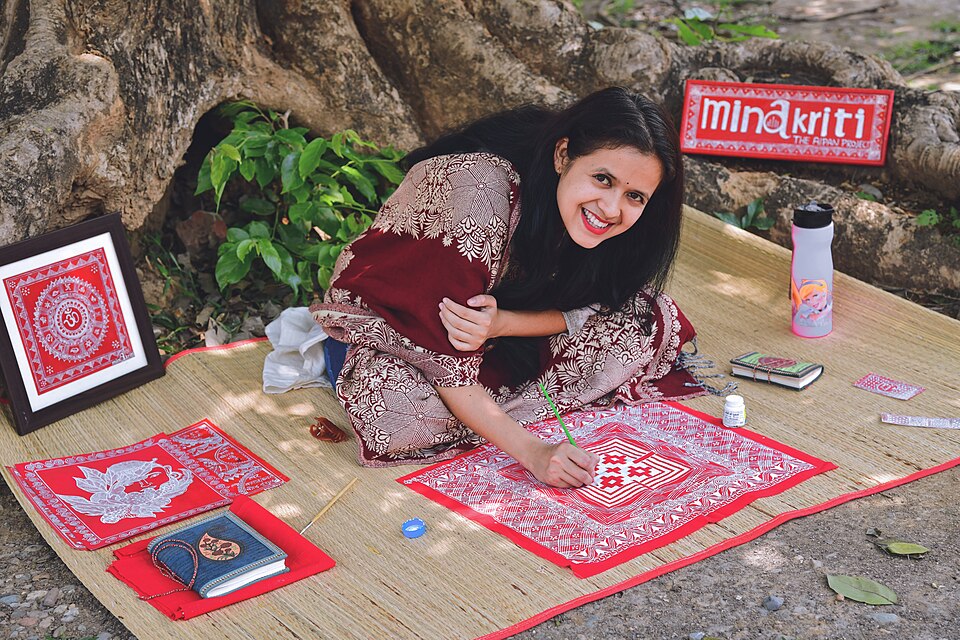
Aipan grew up in Kumaon, and tradition places its flowering under the Chand kings, with Almora as an early centre. It is women's art, passed from mother to daughter, and until recently it was never sold or framed. It existed only where it was needed: on the floor before a deity, at the head of a stairway, around the tulsi plant, on the seat where a bride or a newborn would sit.
The technique is simple and exacting. The surface is first washed with geru, a wet red-brown ochre, to make the ground. The lines are then drawn with biswar, a paste of ground soaked rice, using the last three fingers rather than a brush. There is no sketching and no correcting, so the geometry, the dots and the looping vines are held entirely in the artist's memory and hand.
Each occasion has its own design, called a chowki or peeth. A Saraswati chowki is drawn when a child begins learning, a Lakshmi design at Diwali with the goddess's tiny footprints walking in, a Nav Durga chowki during the goddess festivals. The motifs carry meaning: the swastika, the conch, the lotus, the fish and interlocking triangles all recur.
Aipan has lately moved off the floor and onto paper, cloth, stationery and decor, which has given a new generation of Kumaoni women a small livelihood and kept the form alive. The GI tag of 2021 recognised it formally as a craft of Uttarakhand.
Common aipan designs
- Saraswati ChowkiDrawn when a child starts education
- Lakshmi ChowkiDiwali, with the goddess's footprints
- Nav Durga ChowkiThe nine forms of the goddess
- Jyoti PattaA lamp-and-light motif for worship
- Chamunda Hast ChowkiFor specific goddess rituals
- VasudharaRows of dots for prosperity